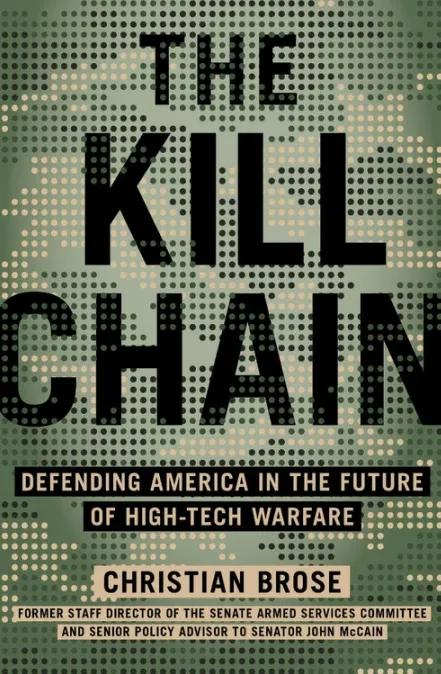
By any measure, Kill Chain by Christian Brose is one of the most important defense books written in the past decade, not because it introduces new weapons or technologies, but because it reframes how power is applied, decisions are made, and security is sustained in an era of rapid technological change.
Although the book is often discussed in the context of high-end conflict with near-peer adversaries, its most relevant lessons may apply closer to home: ports, shipyards, coastal infrastructure, and maritime security operations that sit at the intersection of deterrence, compliance, and real-world risk.
As Christian Brose writes in Kill Chain, “The future of war is not about platforms. It’s about the ability to link sensors, decision-makers, and shooters faster than an adversary can disrupt them.” That observation is as relevant to ports and shipyards as it is to high-end conflict.
At its core, Kill Chain reframes modern conflict around speed of thought and action, achieved through integrated systems rather than standalone platforms. That distinction matters profoundly for maritime security professionals navigating an environment where threats are increasingly asymmetric, ambiguous, and technologically enabled.
The Kill Chain, Properly Understood
In military doctrine, a “kill chain” describes the sequence of actions required to identify a target, decide on a course of action, and execute that decision. Brose’s central insight is that modern conflict, and modern security, hinges on the speed and resilience of this sequence, not the destructive capacity at the end of it.
Brose is explicit that modern advantage does not come from owning the most advanced individual systems. As he notes, “We have mistaken exquisite platforms for military advantage, when advantage increasingly lies in how information moves through an organization.” In maritime security, this distinction is critical; patrol boats, guards, and sensors only matter if they are fused into a coherent decision system.
This idea is not new to naval professionals. Decades earlier, strategist Wayne Hughes framed the same principle succinctly: “The essential requirement for victory is to make correct tactical decisions faster than the enemy.” Brose’s argument is less a revolution than a reminder, one that modern technology now makes achievable at scale.
The United States, Brose argues, has optimized for dominance at the final step: the shooter. Adversaries, by contrast, are attacking the entire system; overwhelming sensors, confusing command structures, and compressing decision timelines until even superior forces struggle to respond.
This critique aligns closely with recent discussions published by institutions such as the Naval Institute, where authors have increasingly emphasized decision advantage and distributed operations over platform-centric solutions. The problem is not a lack of capability; it is a lack of integration.
This bias toward the “last mile” of force application is particularly dangerous in maritime environments, where ambiguity is the norm and response options must remain proportional. A delayed or fragmented decision loop at sea does not merely risk failure, it risks escalation, miscalculation, or loss of control in legally and politically constrained spaces.
At its core, Kill Chain is a book about time and pressure. Brose argues that “in future conflict, the side that can make effective decisions faster, across more domains, and under greater pressure, will win.” For maritime security operators, this translates directly into how quickly threats are identified, understood, and addressed before they escalate.
Most ports and shipyards already possess patrol boats, guards, cameras, and procedures. What they often lack is a coherent, integrated decision system that fuses these elements into a responsive whole.
Platforms Are Not the Point, Networks Are
One of Kill Chain’s most compelling arguments is that traditional thinking remains anchored to platforms: ships, aircraft, and systems optimized for singular performance metrics. Meanwhile, adversaries are fielding cheap, networked, and disposable systems designed to stress the defender’s ability to sense, decide, and coordinate.
This dynamic has been widely explored in Proceedings and related publications of the Naval Institute, particularly in discussions of unmanned systems and maritime domain awareness. The takeaway is consistent: a sensor that is not connected to a decision-maker is just noise.
Brose’s argument implicitly challenges maritime operators to stop asking, “What platform do we need?” and start asking, “How does information move from detection to decision to action?”
Ukraine: The Lesson Everyone Quotes, But Few Fully Understand
In port and shipyard environments, this reality is already visible. Human patrols, fixed sensors, and waterborne assets frequently operate in parallel rather than in concert. The result is a form of vulnerability that compounds rather than corrects itself.
Ukraine’s battlefield innovation features prominently in Kill Chain, and for good reason. Low-cost drones, rapid adaptation, and decentralized command structures have repeatedly offset Russia’s numerical and material advantages.
Yet the true lesson is not the technology itself. It is the organizational willingness to collapse decision loops.
As analysts at the Center for Maritime Strategy have noted, modern conflict increasingly rewards forces that can distribute authority, empower operators, and integrate sensors and shooters across domains. Ukraine’s success stems from pairing human judgment with machine-enabled speed.
This has direct maritime relevance. Ports and coastal infrastructure are constrained environments where ambiguity is the norm. Contacts are not neatly labeled as hostile or benign. The ability to rapidly assess intent, and respond proportionally, depends on human judgment supported by autonomous integrated systems, but not replaced by autonomous systems; because it seems it is the pairing together of human and machine that is enabling such effective action.
The Maritime Blind Spot in Kill Chain Thinking
One limitation of Kill Chain is that it is often interpreted through an air and missile defense lens. Maritime environments introduce complexities that challenge simplistic applications of kill chain logic.
Maritime security requires:
- Persistent presence rather than episodic response
- Restraint and escalation control rather than immediate engagement
- Compliance with legal and regulatory frameworks alongside operational necessity
These constraints do not weaken the kill chain concept; they make its correct design more important. These realities demand a defensive kill chain optimized for awareness, attribution, and deterrence, not destruction.
This perspective has been echoed in recent Maritime Industrial Base discussions, where contributors emphasize that maritime security failures often result not from lack of force, but from gaps in coordination and clarity across public and private stakeholders.
Human Judgment Still Anchors the Chain
Despite frequent claims that autonomy will replace human decision-making, Brose is clear-eyed about its limits. He writes, “Technology can accelerate decision-making, but it cannot replace judgment.” Nowhere is this more evident than in maritime security, where rules of force, escalation control, and contextual awareness demand experienced human operators in the loop.
This is especially true in maritime security. Vessel identification, escalation decisions, and coordination with authorities require contextual understanding that machines alone cannot provide.
The future, as Kill Chain implies, belongs to human–machine teams, operators empowered by technology rather than displaced by it. This mirrors conclusions frequently drawn in Naval Institute forums examining unmanned systems integration: autonomy amplifies human effectiveness, but does not replace responsibility.
Deterrence Begins Before the Shot
Perhaps the most underappreciated insight of Kill Chain is its implication for deterrence. A functioning kill chain deters through awareness, credibility, and inevitability, not the promise of destruction.
In maritime environments, deterrence is achieved when adversaries believe:
- They will be detected early
- Their actions will be understood correctly
- A proportional response will follow
Importantly, Brose reminds readers that the most effective kill chains are often invisible. As he observes, “The most effective kill chains may never need to be completed, because their existence deters action in the first place.” In maritime security, success is measured not by engagements but by incidents that never occur.
This is not theoretical. It is the daily reality of effective port and shipyard security.
Brose’s framework encourages maritime professionals to think of deterrence as a systemic outcome, not a product of any single asset or guard force.
Where Kill Chain Needs Operational Ground Truth
While Kill Chain is persuasive, practitioners will recognize gaps between theory and execution. Integration is harder than acquisition. Sustainment, training, and operational testing receive less attention than they deserve.
This is where private-sector companies like Six Maritime and maritime security professionals provide essential grounding. Systems must function in weather, congestion, and ambiguity; conditions rarely captured in controlled demonstrations. They must be maintainable, trainable, and legally defensible.
The distinction matters. A kill chain that works once is a demonstration. A kill chain that works every day is security. This is the difference between conceptual relevance and operational credibility.
Why Kill Chain Is Required Reading for Maritime Security Leaders
Ultimately, Kill Chain is not a book about drones or warfighting alone. It is a book about organizational courage, the willingness to rethink assumptions, distribute authority, and accept managed risk in pursuit of adaptability.
For maritime security leaders, the message is clear:
- Technology without integration is wasted potential
- Compliance without adaptability is fragility
- Presence without awareness is theater
One of Kill Chain’s more uncomfortable conclusions is that technology is rarely the limiting factor. Brose argues that “the hardest part of reform is not technology, it is changing how organizations think and act.” For maritime security leaders, this may be the book’s most relevant, and most challenging, insight.
The future of maritime security will be shaped by those who understand that decision advantage, not firepower, is the true currency of security.
For organizations responsible for protecting ports, shipyards, and coastal infrastructure, Kill Chain is not an abstract defense treatise. It is a warning and an opportunity. The future belongs to operators who can integrate people, technology, and authority into systems that function every day, under real constraints, in live environments.
Kill Chain names the problem. Maritime security professionals need to build the solution.