
There is a pattern buried inside the National Security Strategy that’s easy to miss if you skim it too quickly: while the document is framed at the strategic level, nearly every section that touches the oceans hints at an uncomfortable truth, our legacy maritime security posture is no longer optimized for the threat landscape we actually live in.
Much of our national security architecture still assumes predictable adversaries operating predictable platforms in predictable ways. That era is over. The world’s gray zone actors, state and non-state alike, are moving faster than our regulatory frameworks, acquisition pipelines, and operational playbooks. The Strategy acknowledges this without saying it explicitly: any security enterprise that cannot adapt at speed will be outpaced by adversaries who can.
This isn’t theoretical; it’s playing out right now on the waterline.
The acceleration of maritime threats
The Strategy’s section on maintaining maritime superiority focuses heavily on deterrence, alliances, and freedom of navigation, all foundational, all essential. Yet beneath those pillars is something newer: a recognition that threat velocity is now a defining feature of the maritime domain.
Autonomous surface vessels (ASVs) jury-rigged for attack. Commercially available drones weaponized for harassment or ISR. Divers and saboteurs exploiting unmonitored spaces of commercial ports. Foreign intelligence gathering via maritime proxies.
Every one of these threats can materialize faster than our traditional security stack can respond.
And at the most vulnerable seams, naval ship repair facilities, commercial shipyards, offshore energy nodes, and high-density port complexes, the gap between threat evolution and defensive modernization becomes most apparent.
Our national strategy calls for modernization. The waterfront demands it.
Human–machine pairing: the necessary bridge
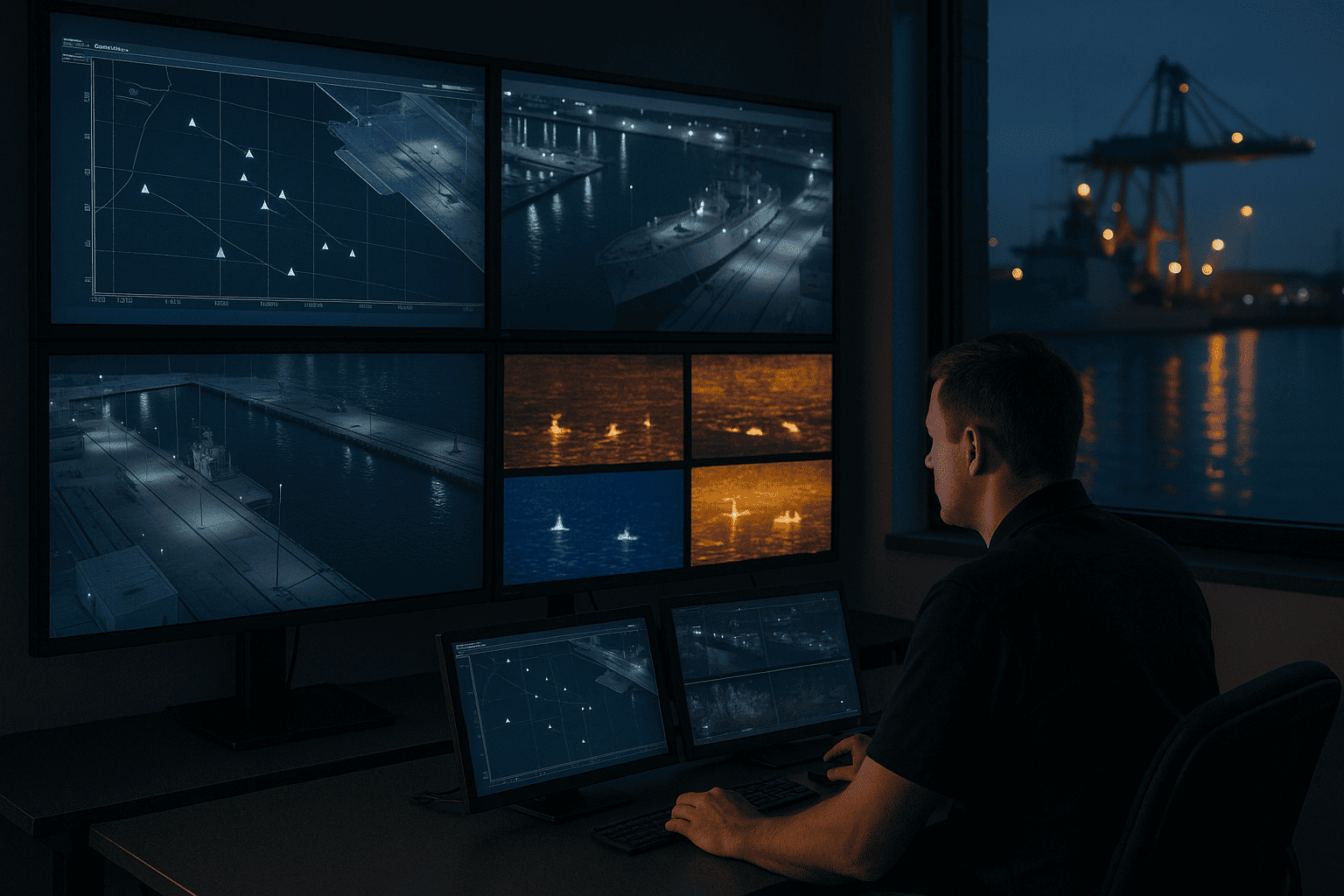
Here is where the Strategy’s intent meets the operational reality Six Maritime has been pushing toward for the past two years: a hybrid model of human expertise paired with autonomous systems, tailored sensors, and AI-enabled situational awareness.
If anything, the NSS amplifies what Six Maritime staff has been saying internally for months: the security model that will define the next decade is not fully autonomous, it is selectively autonomous, layered, adaptable, and accountable.
A future-proofed maritime security stack will include:
- Precision detection using commercial-off-the-shelf sensors (thermal, RF, sonar, above/below-surface analytics).
- Autonomous intercept capability, not offensive, but defensive, designed to counter fast-moving unmanned threats on the surface.
- Persistent domain awareness using fixed and mobile nodes across piers, channels, and critical chokepoints.
- Human operators who understand shipyard rhythms, vessel movements, and the subtleties of maritime behavior patterns that machines cannot yet interpret.
- An integrated command-and-control layer that turns noise into actionable decision-making.
The Strategy calls for a resilient defense industrial ecosystem. On the waterfront, that resilience begins with operational adaptability, the ability to fuse human judgment with machine precision in real time.
Why private shipyards matter in this shift
The NSS highlights critical infrastructure protection but stops short of discussing a fundamental vulnerability: naval ship repair facilities are now part of the national defense kill chain.
They are not simply industrial work sites; they are high-value targets. Yet many still rely on security models designed for an era before autonomous threats, before saturation swarms, before ubiquitous ISR.
Modernization cannot stop at the gates of public shipyards. Private yards repairing US naval vessels must be integrated into the national maritime security architecture technologically, procedurally, and defensively. The Strategy’s emphasis on “resilient supply chains” implicitly includes these yards. The question is whether the security posture at these facilities will evolve at the required pace.
Where Six Maritime fits into the modernization arc
Six Maritime sits at a unique intersection:
- We conduct daily waterborne security operations at major naval ship repair facilities.
- We support R&D, chase boat operations, and offshore test events for emerging unmanned systems developers.
- We help shape practical CONOPS for integrating AI, sensors, and USVs into real security environments.
- And now we are building the operational template for coastal installation protection that merges human and machine capability.
This is not a conceptual exercise. It is grounded in hours on the water, in the lessons learned from NAVSEA 009-72 enforcement, in working side-by-side with engineers testing autonomous vessels at shipyards, and in seeing firsthand where legacy systems fall short.
The modernization the National Security Strategy calls for is already happening on the waterline and we are seeing it with our security vessel crews and support personnel.
The forward path
As the Strategy makes clear, national security modernization is not driven solely by new federal funding, it is driven by the willingness of operators, innovators, and industry partners to adapt faster than adversaries evolve.
For the maritime sector, this means:
- Treating shipyards as strategic defense nodes.
- Treating autonomous systems as force multipliers, not replacements.
- Treating domain awareness as the foundation for every security decision.
- And treating operational innovation as a daily habit, not a future aspiration.
If our national strategy is the blueprint, then the waterfront is where the blueprint becomes real.
And that is where Six Maritime intends to lead.