
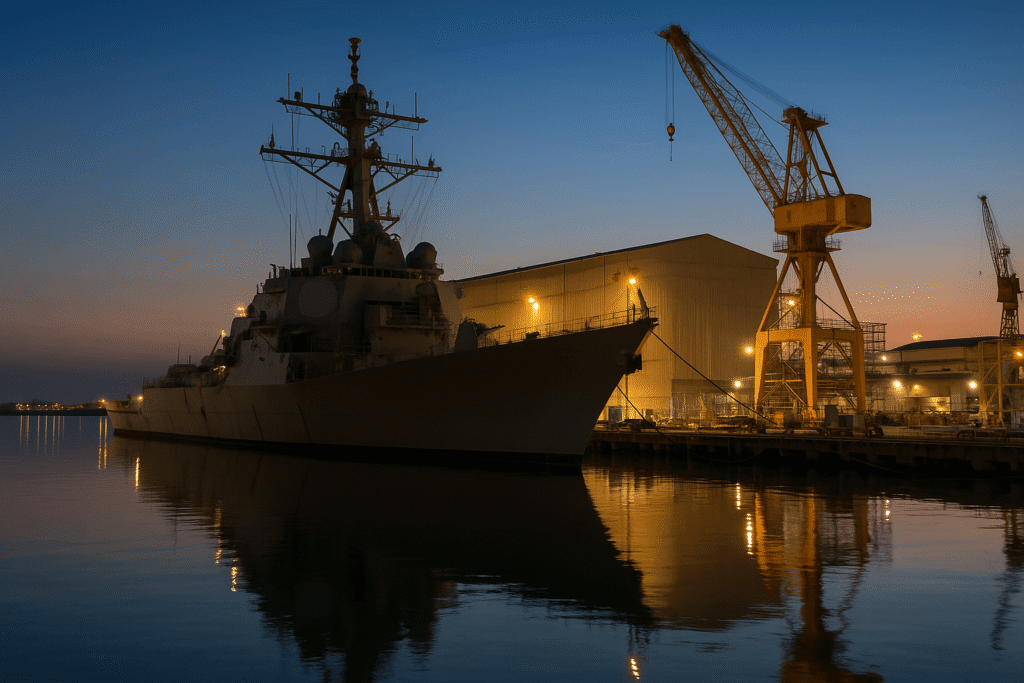
The White House’s 2025 National Security Strategy (NSS) is blunt about the stakes for the United States. America’s economic strength, industrial resilience, and national security are now understood as inseparable. The document repeatedly emphasizes reindustrialization, supply-chain independence, and revitalizing the defense industrial base as top national imperatives. According to the NSS, “the future belongs to makers,” and rebuilding domestic manufacturing is essential to deterring conflict, maintaining naval superiority, and safeguarding American prosperity.
But as the conversation in Washington gravitates toward tariffs, reshoring, industrial incentives, chip production, and supply chain mapping, one critical reality is consistently overlooked:
The entire national reindustrialization effort sits on top of an undersecured maritime foundation.
Every ship, submarine, autonomous platform, munition, and critical component must move through American ports, shipyards, and maritime logistics hubs. And yet, despite its central role in national security, the maritime industrial base remains one of the least modernized, least standardized, and least protected components of American infrastructure.
If the United States intends to execute the NSS and rebuild its industrial strength, then the security of our shipyards, private naval repair facilities, and commercial ports cannot remain an afterthought. They are not merely economic node, they are strategic assets. And today, they are among the most exposed.
The NSS Makes One Thing Clear: Supply Chain Security Is National Security
Throughout the 2025 NSS, the administration emphasizes that America must secure access to critical materials, rebuild domestic manufacturing, and strengthen the defense industrial base. The document argues that the United States must “re-shore industrial production… and ensure that our country is never again reliant on any adversary, present or potential, for critical products or components”.
This is not an abstract point. Reindustrialization is not just an economic objective, it is the foundation of America’s long-term military competitiveness. Nowhere is this more evident than in the maritime sector, where shipbuilding, repair, and sustainment capacity have fallen behind geopolitical demand.
Yet here is the paradox:
The U.S. is trying to rebuild its industrial and naval power on top of a waterfront infrastructure that is not aligned with modern threat environments.
The NSS calls for revitalizing production lines, expanding maritime capacity, and strengthening the defense industrial base. But the shipyards and ports that will shoulder this burden remain vulnerable to the very risks the strategy is designed to mitigate: foreign interference, illicit activity, sabotage, and operational disruption.
This disconnect must become part of the national conversation. America cannot scale production, accelerate repair cycles, or prepare for a contested maritime environment if the industrial facilities that enable these missions are left behind.
America’s Maritime Industrial Base Is the Weak Link in the Strategy
At the core of the problem is a simple reality: Maritime infrastructure security has not kept pace with the strategic demands placed upon it. For decades, private shipyards, repair facilities, and commercial ports have operated under a patchwork of regulations, inconsistent standards, unfunded mandates, and legacy security models. While the threat landscape evolved, state actors probing cyber networks, opportunistic intrusions on the waterfront, drones over sensitive facilities, and unconventional maritime approaches, the security architecture of many industrial waterfronts remained fundamentally unchanged.
The NSS calls specifically for a “resilient national infrastructure that can withstand natural disasters, resist and thwart foreign threats, and prevent or mitigate events that might disrupt the American economy”. Yet the shipyards and facilities most essential to naval readiness are typically treated as commercial real estate tenants rather than strategic assets.
We know this because we see it every day.
At Six Maritime, our teams work across multiple private naval repair facilities, supporting NAVSEA 009-72 compliance, providing waterborne security, and mitigating threats to vessels undergoing maintenance or modernization.
What we observe across the industry is consistent:
- Security standards vary wildly from facility to facility.
- The burden falls on contractors who must “make do” despite the heightened profile of the vessels in their berths.
- Threat vectors are increasing, from swimmers and small craft to drones, cyber intrusion, and intelligence collection.
- And perhaps most importantly—
- No one is accountable for creating a unified maritime industrial base security standard.
If these conditions persist, then reindustrialization, the centerpiece of the NSS, will be built on unstable ground.
Lessons from History: Waterfront Vulnerability Is Not a Hypothetical Threat
Maritime security professionals are often accused of thinking in “worst case scenarios.” But history validates the concern.
The USS Cole attack remains one of the most sobering examples of what a small, inexpensive, unconventional maritime threat can inflict on a high-value naval asset. The core lesson was not solely about vigilance, it was about the cost of overlooking the asymmetric pathways that determined adversaries will exploit. The Cole attack succeeded because it approached from the water, under the threshold of traditional security assumptions.
Today’s adversaries have more tools, more access, more technology, and more incentive to explore those same gaps.
When a naval vessel enters a private shipyard for repairs or modernization, it becomes more—not less—vulnerable. Systems are offline. Power cycles constantly fluctuate. Crews are minimal. Access points multiply. And the industrial environment introduces hundreds of unfamiliar personnel with varying levels of clearance, oversight, and training.
In other words, a U.S. naval vessel in a shipyard is often at its most defenseless.
Yet as a country, we continue to behave as if the waterfront is peripheral to national security.
Reindustrialization Requires Throughput, But Throughput Requires Security.
- If foreign intelligence collection increases near a shipyard preparing a major availability, delays follow.
- If a security breach forces a lockdown, operations halt.
- If an unauthorized drone captures imagery of vessel work, adversaries gain insights into capabilities or vulnerabilities.
- If the waterfront is compromised, physically or digitally, the entire enterprise slows or stops.
- Reindustrialization depends on reliability, not just capacity.
- Reliability requires security, not assumptions.
- And security requires professionalization, not improvisation.
- This is the link missing from the NSS dialogue.
The Modern Maritime Threat Environment Requires a New Standard
Is dynamic, fluid, and cTraditional port security models (land-based guards, cameras, fences, and access control) cannot manage the full spectrum of modern maritime threats. The waterfront is dynamic, fluid, and contested. Threats evolve faster than regulations.
Six Maritime has spent years building an operational architecture that reflects reality, not assumptions:
- Dedicated waterborne security teams trained in accordance with NAVSEA 009-72 and threat-driven best practices.
- Real-time maritime domain awareness, integrating radar, AIS, thermal systems, and patrol patterns.
- Predictive threat analysis built from operational experience across high-traffic naval repair environments.
- Rapid-response capabilities, including nighttime interdiction, swimmer detection, and small-craft maneuvering.
- Tactical integration with shipyard operations, aligning seamanship with industrial safety and Navy requirements.
The existing norms, posting a guard at the gate and relying on a roving patrol, were not designed for an era of autonomous drones, foreign intelligence proxies, or surveillance conducted from offshore. If America wants to rebuild its fleet and its industrial base, then the security of the waterfront must evolve.
Technology Will Be a Force Multiplier, Not a Substitute
The NSS devotes significant attention to emerging technologies, especially AI, autonomy, and unmanned systems. It emphasizes the need to “preserve and advance our advantage in cutting-edge military and dual-use technology,” including autonomous systems and the technologies that fuel them. This is where the future is heading, and rightly so.
But in the maritime security environment, technology is most effective when paired with trained operators, strong procedures, and well-exercised command and control. Autonomous surface vessels (USVs) can extend coverage, reduce costs, and provide persistent presence, but only when integrated into a broader security framework.
The goal is augmentation, not replacement.
We foresee a near future where:
- USVs patrol perimeters autonomously, feeding data to an operations center.
- AI-enhanced surveillance identifies anomalies long before human detection.
- Thermal, radar, and sonar-based swimmer detection fill the nighttime blind spots.
- Multi-sensor fusion gives shipyards a common operating picture they have never had before.
This future aligns perfectly with the NSS emphasis on American technological superiority. But it will not happen on its own. It requires pilots, partners, and integrators. It requires overcoming the industry’s initial discomfort with autonomy. And it requires leadership willing to acknowledge that security cannot remain static.
Private Shipyards Are Strategic Assets, They Must Be Treated Accordingly
The U.S. Navy increasingly depends on private shipyards for repair, modernization, and sustainment. These facilities now form an essential complement to public yards, absorbing overflow, accelerating timelines, and expanding capacity.
Yet while the NSS articulates the need to protect critical infrastructure and strengthen industrial resilience, most private yards lack:
- Dedicated federal funding streams for maritime-focused security upgrades.
- Standardized waterborne security requirements across geographic regions.
- Technology modernization pathways for domain awareness, perimeter detection, or autonomous patrols.
- Unified training standards for guard forces performing sensitive missions.
- Clear guidance on emerging threats such as foreign-owned adjacent land, surveillance vessels, or unmanned platforms.
In practical terms, this means that mission assurance for naval vessels afloat in private yards is heavily dependent on the capability of private security providers, and yet those providers are often constrained by legacy rules, unclear cost structures, or contractual ambiguity. For the NSS to succeed, this must change.
Toward a New Framework for Maritime Industrial Security
While national security strategy often focuses on geopolitics and global posture, the work of securing America’s shipyards resides in daily routines: patrol patterns, access control, detection systems, emergency procedures, communication lines, and trained personnel.
A modernized framework might include:
- 1. Recognizing private naval shipyards as critical national infrastructure
- This elevates security expectations and forces federal alignment on best practices.
- 2. Standardizing waterborne security requirements across all facilities handling naval vessels
- NAVSEA 009-72 should evolve to meet contemporary threat realities.
- 3. Incentivizing technology adoption
- Including autonomous systems, AI-enhanced perimeter monitoring, and advanced detection tools.
- 4. Building public–private security integration models
- Not replacing Coast Guard or Navy roles, but creating complementary architectures that fill gaps.
- 5. Embedding training and qualification standards for maritime guard forces
- To ensure consistent performance regardless of geography.
The goal is not regulation for its own sake, it is security for the sake of national resilience. The NSS gives us a roadmap for revitalizing our industrial base. But we must build that base on a foundation that can withstand the pressures of a contested maritime century.
Reindustrialization Begins at the Waterline
The 2025 National Security Strategy is clear: America must rebuild, resecure, and reassert its industrial and maritime strength. But we cannot achieve that vision if the shipyards and ports responsible for repairing our fleet, moving our critical goods, and sustaining our naval capabilities remain under-protected.
Shipyard and port security are no longer local operational concerns, they are strategic determinants of national power.
As a maritime security company operating at the intersection of DOD requirements, industrial capacity, and technological innovation, we see firsthand both the urgency and the opportunity. The United States is entering a period of renewed maritime competition. Our industrial base will be tested. Our infrastructure will be targeted. And our ability to build, repair, and sustain the fleet will depend on how seriously we treat the security of the waterfront.
At Six Maritime, we believe the path forward is clear:
Protect the foundation, and the strategy can succeed. Ignore it, and everything built atop it is at risk.
This is the moment for industry leaders, policymakers, and shipyards to come together and align security with national strategy. The future of American maritime power, and the success of the National Security Strategy, depends on it.