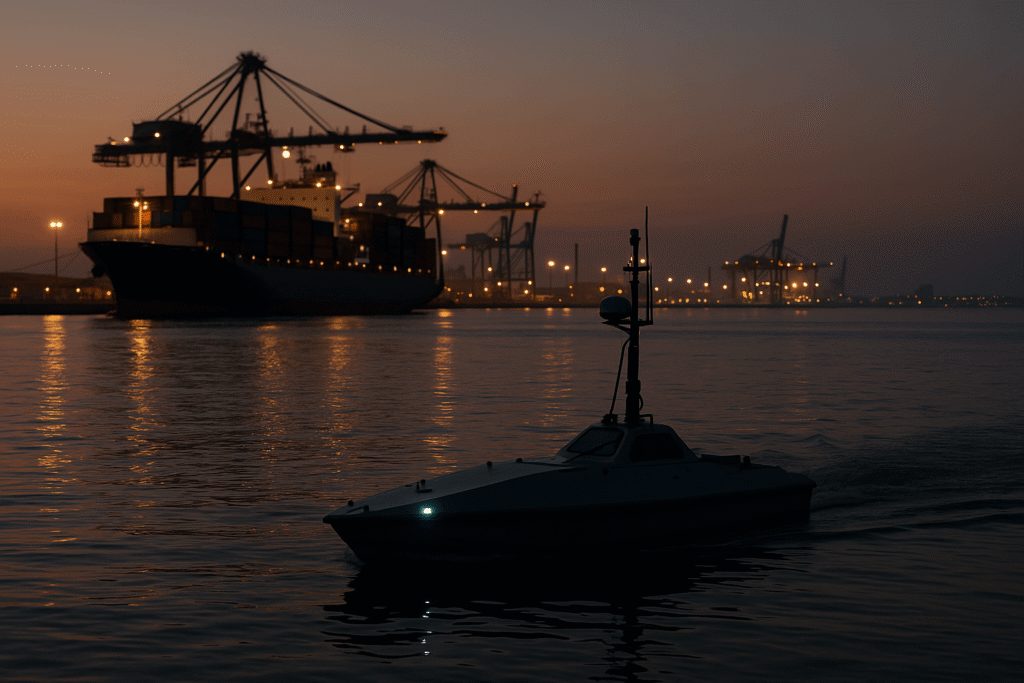
There are moments in maritime security when the world offers a rare glimpse of where the next decade is headed. The recent attacks on the MT Kairos and MT Virat in the Black Sea were exactly that. The videos that spread across OSINT feeds and defense channels weren’t remarkable because they were shocking, they were remarkable because they were predictable. Unmanned surface vehicles, once little more than remote-controlled novelties, have matured into stable, fast, low-profile attack platforms with enough precision to hit a vulnerable point on a tanker traveling at speed. What the world saw play out on those videos was not an anomaly. It was the future asserting itself.
If you’ve followed maritime security developments over the past several years, you’ve watched the evolution of these systems with a mix of fascination and unease. They’ve gone from improvised skiffs packed with explosives to hydrodynamically refined craft capable of navigating on autopilot, evading small arms fire, and delivering a payload to the exact spot where a ship can least afford to be hit. But while the Navy, the Coast Guard, and the defense press have focused on what these threats mean for warships underway, the truth is that the real vulnerability, the one that should keep security directors awake at night, lies much closer to home.
The U.S. maritime industrial base, the private shipyards entrusted with maintaining the fleet, and the ports that keep the American economy running are not protected by destroyer-class combat systems. They are protected by contract-funded guard forces, legacy camera networks, small patrol boats with tired crews, and security models designed for a world before unmanned surface threats became routine. The Kairos and Virat attacks are a stark reminder that this environment has changed and that the defenses guarding America’s shipyards and ports have not.
Watch the footage again with that in mind. A small hull slices through the waterline almost invisibly, presenting barely any radar return and even less reaction time. It maneuvers with a stability that belies its size. Warning shots, if there were any, would have meant nothing. A patrol boat would have struggled to close the distance. A human lookout scanning the horizon would have been lucky to spot it before it was too late. The camera that did capture its final run-in was pointed in the right direction by chance, not design.
These attacks illustrate one of the most important truths in modern maritime security: you do not counter a fast, unmanned surface threat with slow, manned legacy tools. The physics, the reaction time, and the engagement geometry all favor the attacker. A USV can approach low on the water, at high speed, unmanned and unafraid of gunfire, with a target profile so small that hitting it from a moving platform becomes a matter of luck more than skill. The defender is constrained by human limits; the attacker is constrained by none.
This is the asymmetry that should concern every port director, every shipyard FSO, every Navy program office responsible for out-of-port security, and anyone who believes the maritime industrial base is too important to leave exposed. For years, private shipyards have been required to foot the bill for waterborne protection through fixed-price contracts, a model that incentivizes cost-cutting, not capability-building. The result is a patchwork of minimally compliant programs that may check all the regulatory boxes but are structurally incapable of dealing with a threat that moves at 35 knots and doesn’t blink.And yet, within this challenge is an extraordinary opportunity.
The future of maritime security will not belong to companies that cling to old models or treat unmanned systems as a marketing buzzword. It will belong to the companies that truly understand both worlds: the legacy operational environment of shipyard and port security, and the new technological world of autonomous vessels, advanced sensors, and AI-enabled maritime domain awareness. The organizations that will define the next decade are the ones that can integrate these realities into a cohesive, scalable, operationally sound defensive architecture.
This is where Six Maritime stands apart.
For more than a decade, Six Maritime has earned its reputation by protecting naval vessels under NAVSEA 009-72, supporting R&D programs with emerging unmanned systems developers, and fielding teams capable of operating in some of the most complex waterborne environments in the country. Where other companies silo themselves as traditional guard providers or purely tech-forward startups, Six Maritime occupies the space that actually matters: the intersection of human operational excellence and technology integration.
Long before the Kairos and Virat attacks drew headlines, Six Maritime had already been testing autonomous platforms, integrating emerging sensor technologies, and shaping new concepts of operation that blend human judgment with machine precision. Our teams have taken prototype systems into real sea states, pushed them to failure points, and learned what does and does not work on the water. We understand the gap between a glossy PowerPoint promise and actual operational viability, because we’ve tested every claim firsthand. And we’ve done it with the mindset of practitioners, not theorists.
The lesson from those tests, and from the attacks in the Black Sea, is unmistakable. The only sustainable way to defend ships, ports, and shipyards against unmanned surface threats is through human–machine teaming. Trained waterborne operators, equipped with small autonomous interceptors and supported by a layered sensor network, are the only combination that can consistently detect, track, and counter USVs at the speed of relevance. Cameras alone won’t do it. Patrol boats alone won’t do it. Manual gunfire certainly won’t do it. But the fusion of people and autonomy can.
And that is exactly what Six Maritime is building.
Ports and shipyards need a partner who understands their world, the regulatory requirements, the operational rhythms, the constraints of working on tight margins and tighter timelines. They also need a partner who can guide them into the future, a company capable of designing, deploying, and maintaining autonomous systems without overwhelming the customer or disrupting operations. They need someone who can stand up a compliant waterborne security program today and integrate next-generation autonomous capabilities tomorrow. They need someone who can translate cutting-edge technology into real-world security outcomes.
They need a company that has stood the watch, understands the threat, and is already working on the solution.
Six Maritime is that company.
The attacks on Kairos and Virat were warning shots, not just for navies, but for every nation that depends on secure maritime infrastructure. The threat is evolving whether we adapt or not. The only question is who will lead that adaptation, and who will be left reacting to it.
If you are responsible for protecting a port, a shipyard, or the vessels entrusted to your facility, the time to act is now. The threat is already here. The technology is ready. The path is clear.
Six Maritime is prepared to help you modernize your defenses, integrate autonomous capabilities, and build a security architecture designed for the world as it actually exists, not the one we wish we still lived in.
The future of maritime security has arrived.
Let us help you shape it.